Wednesday, August 29, 2012

THE SCREENING ROOM

 Visit The Screening Room

"The film of tomorrow appears to me as even more personal than an
individual and autobiographical novel, like a confession, or a diary."

- Francois Truffaut  


The Screening Room is currently comprised of TEN "theatres" - or channels - each specialising in different kinds of film and/or television stories.  These are:
          
         1. Features
         2. Documentaries
         3. Short Films
         4. Avant Garde/Experimental cinema
         5. Iranian films
         6. Television 
         7. Trailers
         8. Tribal Films
         9.  Jazz Films
        10. Web Series

Trailers have been included to alert viewers to films they should see that are not currently available on YouTube. The "art" of the trailer is a very special form of dramatisation, as well, and the trailers featured here provide vivid and succinct examples of the effective use of the essential grammar of dramatic storytelling/filmmaking... PROBLEM, GOAL, PLAN. 


The features (both fictional and factional) present a rather eclectic and distinctly international collection representing a broad range of genres and styles. The choice of these films was driven not so much by their technical excellence - though most of them instance memorable and often brilliant examples of the arts of cinematography, editing, sound, design, etc - but rather because - in most cases - they effectively and imaginatively employ the essential grammar of dramatic screen storytelling and because each, in its own way, is solidly grounded in a "tribal" sensibility that manifests and maintains a wonderful freshness and originality. This is particularly in evidence in the Iranian films, the quality of which is so good and so consistent, I have decided to give these films their own section.

The selected shorts - and PLEASE NOTE: not all of the shorts presented in The Screening Room were chosen by the editors at WHERE'S THE DRAMA? - illuminate in various ways the essential elements of short-form drama. Each in its own way re-contextualises the dramatic problem that defines the main character. For a more detailed account of this, please read the essay, "STORY - the Long and the Short of It" - http://www.wheresthedrama.com/grammar.htm   Those films posted under the name, "scripttools", comprise some of my personal favorites and are among the finest and most potent works of modern dramatic short-form filmmaking. 


If you have made an exceptional, dramatic short-film that employs the essential grammar and principles of dramatic storytelling in ways that are fresh, surprising and thoroughly credible, please share it with us by POSTING IT in the short films section of   The Screening Room. Or, if you feel you have made a film that in some way contributes something original and vital to film culture, please consider posting it in the experimental film section.

There is also a special section dedicated to Jazz films.

Visit THE SCREENING ROOM

Thursday, August 23, 2012

CONCOCTING AN OBSERVABLE REALITY

“All things are beautiful if you have got them in the right order.”
John Grierson


Stick to your deepest concerns. Don’t try to do everything. Debussy found his style by using only those notes that he liked. What are you obsessed by? What haunts your private hours? What do you discover when you go through your own mirror? Tell us, nay, show us! What is going on in the chambers of your Hotel des Folies-Dramatique?

Do what you are most afraid of doing. (Look what Brakhage did. He always feared death intensely; it has been a constant threatening imminence for him. So with the courage that has always made him a trail-blazer, he took his camera tightly in hand and went into the city morgue in Pittsburgh and looked closely and filmed unforgettably the forms of death as they had never been seen before: The Act of Seeing With One’s Own Eyes. )

Don’t think about success, no matter how famous you want to be. Success is out of your hands. That is what other people do with your work.

Don’t make anything with the desire to impress anybody. You are more apt to depress them. Remember the caution of Castaneda’s Don Juan: “Does this path have heart?”
Honor your dreams. The gods visit you in your dreams. C.G. Jung carved over his front door: “The gods are always present, even if uninvited.”

Don’t worry about being original.  A new technique, a new gimmick, is not automatically a new vision. Originality has nothing to do with novelty. The word comes from origin. Thus your original nature is in your roots. As the Zen koan goes: What was original in your nature before you were conceived?”


Keep true to your own nature and you will be original enough. Trust your feelings, intuitions, assumptions, attitudes, and follies. Go deep.

If you want to be avant-garde, never do what the avant-garde is doing. By the time everybody knows what’s new, it’s already old. The true scout of the vanguard is already far out of town, exploring new wilderness. Michaelangelo: “He who follows will never advance.”

The task of the avant-garde is to deal with what nobody else is attending to; to reach the place where you no longer lean on any object, any reference. Or, as with Krishmurti, “the stairway without any railing.” Then you might reach the sphere of innate light, the Mother Light, the light of which all other lights are the children.

When you have made your own room, room will have to be made for you.

Follow your own Weird.  This doesn’t mean that all you have to do is turn on the camera and express yourself. Just as talking has nothing to do with creating, self-expression has nothing to do with art. “Anything goes” may be therapy but that is only prelude to the shaping of visions thus discovered. As in painting it is the frame that defines the image, gives shape, selection, point of view, and crystallizes essences.

Nothing is more stimulating to the imagination than working within limitations.


Baldinucci wrote of Bernini: ‘Preternaturally strong until his last illness, Bernini worked at his sculpture tirelessly, sometimes for seven hours at a time, and always with someone at hand to prevent him from falling off the scaffolding. He worked as if in a trance, and when an assistant urged him to stop and rest, the reply was: “Leave me alone. I am in love.”’

A film is never finished, it is only abandoned. But if we are wise we are not expecting perfection anyway, since nothing in life is perfect, art included. 


“What thou lovest well remains, the rest is dross."
 - Ezra Pound


FOR MORE INSPIRATION TRAVEL HERE

Sunday, July 29, 2012

THE SIGNIFICANCE OF PLOT WITHOUT CONFLICT


In the West, plot is commonly thought to progress by way of a sequence of conflicting actions, or the actions of natural or supernatural forces that oppose the best interests of the characters. In the ensuing and on-going confrontation, one character or another ultimately dominates or is beaten by another character, or by fate or nature. The standard three- and five-act plot structures—which permeate Western media—have erected conflict at the center of the conventional, dramatic story forms. A “problem” appears at the beginning, which leads to a crisis near the end of the first act; and, in the second act, the conflict generated by this evolving crisis takes center stage. Conflict is used to create audience involvement even by many post-modern writers, whose work otherwise defies traditional structure.

The necessity of conflict is preached as a kind of dogma by most contemporary screenwriters’ workshops and Internet “guides” to screenwriting. A plot without conflict is considered dull; some even go so far as to call it impossible. This has so influenced mainstream filmmaking that it has crystallised into templates or formulae that every screenwriter worth his or her salt must follow if they are to create a successful screen story. Yet, is there any ultimate merit in this belief? Does plot necessarily hinge on conflict? Not so long ago, I might’ve answered in the affimative, but to do so is to overlook or even negate the very powerful contribution that mystery, suspense and re-contexualisation contribute to our interest in character actions and motives. To simple-mindedly claim that conflict is essential to a great story tells us more about the West’s prejudices and insularity than it does about the scope and variety of cogent and emotionally compelling narratives.

For countless centuries, Chinese and Japanese storytellers have used a plot structure that does not have conflict “built in”, so to speak. Rather, it relies on exposition, contrast, mystery and suspense to generate interest. This structure is known as kishōtenketsu ( 起承転結 in Japanese, 起承轉合 in Chinese)

Kishōtenketsu contains four acts: introduction, development, twist (or re-contextualisation) and reconciliation. The basics of the story—characters, setting (given circumstances), etc.— are established in the first act and developed in the second. No major changes occur until the third act, in which a new, often surprising element is introduced. In the best stories this element is “planted” or in some way foreshadowed in one of the previous acts, though its ultimate significance is not at first recognised. When this element appears (or re-appears) in the third act - which is the core of this type of plot - it manifests as a kind of structural non sequitur. The fourth act draws a conclusion from the contrast between the first two “straight” acts and the disconnected third, thereby reconciling them into a coherent whole. In the short-form drama this manifests as an idea that the audience takes away after the film has finished, upsetting the audience’s assumptions and expectations and as a result forcing the audience to reconsider its judgements about the story and what it actually means. As a result, the audience goes away from the experience altered or changed in some way.


Kishōtenketsu is probably best known to Westerners as the structure of Japanese yonkoma (four-panel) manga. In its simplest form, it may be illustrated as shown in the four-panel storyboard at the right.

Each panel represents one of the four acts. The resulting plot — and it is a plot — contains no conflict. No problem impedes the protagonist; nothing is pitted against anything else. Despite this, the twist in panel three imparts a dynamism — a chaos, perhaps — that keeps the comic from depicting merely a series of events. Panel four reinstates order by showing us how the first two panels connect to the third, which allows for a satisfactory ending without the need for a quasi-gladiatorial victory.

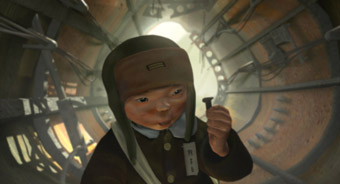
NOTE: Sejong Park’s Oscar-nominated short, Birthday Boy, is a case in point.


The Western structure, on the other hand, is a face-off—involving character, theme, setting—in which one element must prevail over another.

If one were to re-conceptualise the first comic (above) into the formulistic three-act structure of conventional Western screenstorytelling, it might look like the frames below.


The first panel gives the reader a “default position” with which to compare later events; and the second panel depicts a conflict-generating problem with the vending machine. The third panel represents the climax of the story: the dramatic high point in which the heroine’s second attempt ”defeats” the machine and allows the can to drop. The story concludes by depicting the aftermath, wherein we find that something from the first act has changed as a result of the climax. In this case, our heroine sans beverage has become a heroine avec beverage.

What this shows is that the three-act plot, unlike kishōtenketsu, is fundamentally confrontational. It necessarily involves one thing winning out over another, even in a minor case like the one above. This conclusion has wide-ranging implications, since both formats are applied not just to narratives, but to all types of writing. Both may be found under the hood of everything from essays and arguments to paragraphs and single sentences. As an example, the reader might re-examine the first two paragraphs of this article, in which a “default position” is set up and then interrupted by a “problem” (namely, the existence of kishōtenketsu). The following paragraphs deal with the conflict between the two formats. This paragraph, which escalates that conflict by explaining the culture-wide influence of each system, is the beginning of the climax.

As this writer is already making self-referential, meta-textual remarks, it is only appropriate that the article’s climax take us into the realm of post-modern philosophy. It is a worldview obsessed with narrative and, perhaps unconsciously, with the central thesis of the three-act structure. Jacques Derrida, probably the best known post-modern philosopher, infamously declared that all of reality was a text—a series of narratives that could only be understood by appealing to other narratives, ad infinitum. What kinds of narratives, though? Perhaps a benign, kishōtenketsu-esque play between disconnection and reconnection, chaos and order? No; for Derrida, the only narrative was one of violence. As a Nietzschean, he believed that reality consisted, invariably, of one thing dominating and imposing on another, in a selfish exercise of its will to power. The “worst violence”, he thought, was when something was completely silenced and absorbed by another, its difference erased. Apparently, Derrida was uncontent with the three-act structure’s nearly complete control over Western writing: he had to project it onto the entire world. Eurocentrism has rarely had a more shining moment.

Kishōtenketsu contains no such violence. The events of the first, second and third acts need not harm one another. They can stand separately, with Derrida’s beloved difference intact. Although the fourth act unifies the work, by no means must it do violence to the first three acts; rather, it is free merely to draw a conclusion from their juxtaposition, as Derrida does when he interprets one narrative through the lens of another. A world understood from the kishōtenketsu perspective need never contain the worst violence that Derrida fears, which would make his call for deconstruction—the prevention of silence through the annihilation of structure—unnecessary. Is it possible that deconstruction could never have been conceived in a world governed by kishōtenketsu, rather than by the three-act plot? Is the three-act structure one of the elements behind the very worldview that calls for its deconstruction? Can the Western narrative of the will to power remain coherent in the face of a rival narrative from the East? This writer would prefer to ask than to answer these questions…

FOR MORE LIKE THIS  VISIT WHERE'S THE DRAMA?

PLEASE NOTE: THE ABOVE IS A HEAVILY ALTERED VERSION OF AN  ARTICLE THAT FIRST APPEARED ON THE TUMBLR SITE "STILL EATING ORANGES" - a site maintained by an art collective, which describes itself as follows:  "Expect from us illustrations, experimental writing, comics, philosophy, humor, academic and general interest essays, photographs, recommendations and videos."  WHERE'S THE DRAMA graciously and gratefully acknowledges and credits their original article.